









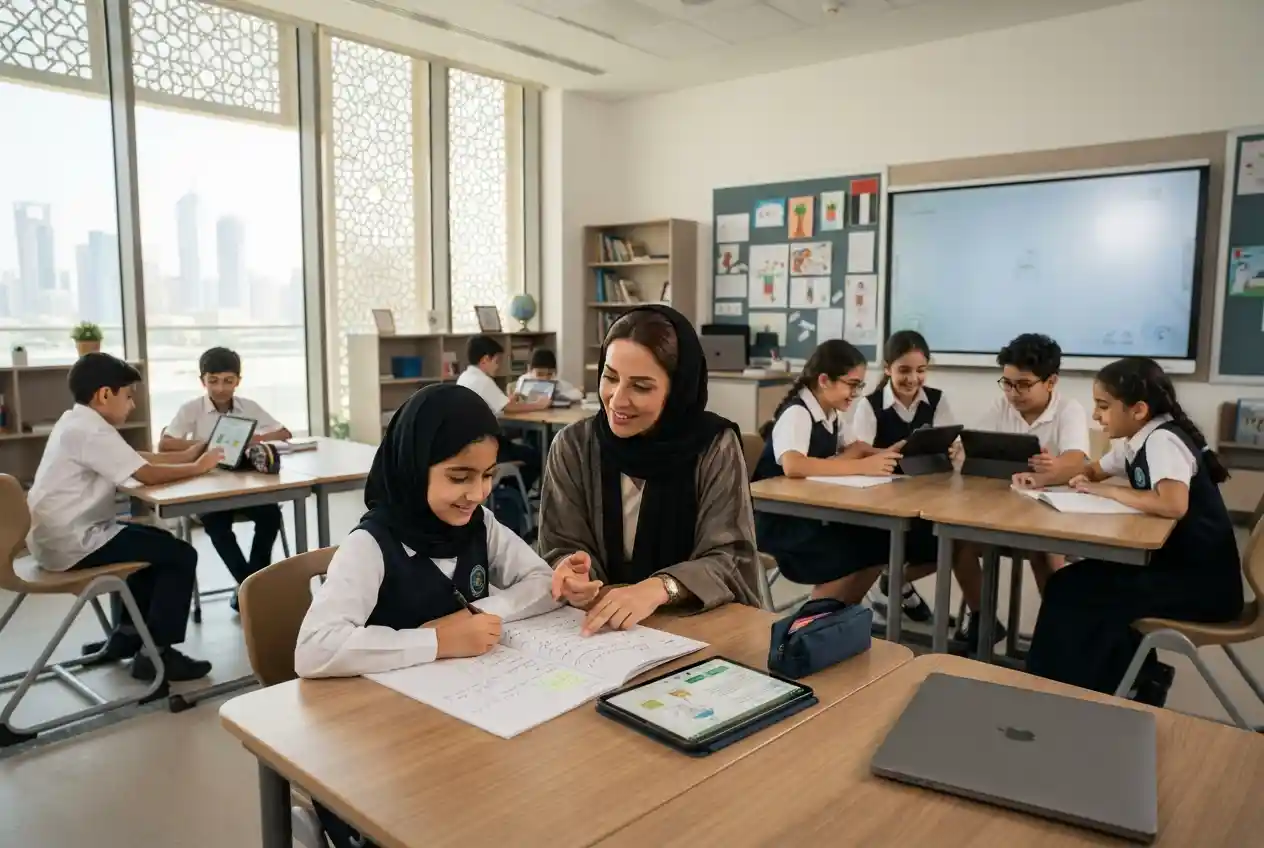
Educational assessment is an essential part of the learning process because it provides evidence about what students know, understand and can do. In the UAE, assessment supports classroom learning, academic progression, institutional quality and wider education planning.
Assessment is often associated with examinations, but modern student assessment can involve much more than a final test. Teachers may use classroom activities, projects, assignments, observations, quizzes and other methods to understand student progress. Different forms of assessment can serve different purposes, from identifying learning needs to evaluating achievement at the end of a course.
The UAE Ministry of Education’s Student Assessment Policy Guide for the 2025–2026 academic year provides a framework covering diagnostic, formative, summative and project-based assessment from Kindergarten through Grade 12, alongside moderation and quality assurance mechanisms. ([moe.gov.ae](https://www.moe.gov.ae/en/guides/Pages/Student-Assessment-Policy-Guide-2025-2026.aspx?utm_source=chatgpt.com))
What Is Educational Assessment?
Educational assessment is the process of collecting and interpreting evidence about student learning. Its purpose can range from identifying what a learner already knows to determining whether learning objectives have been achieved.
Assessment can be informal or formal. A teacher asking questions during a lesson is a simple form of assessment, while a structured examination is a more formal example.
The most effective assessment approach depends on the learning objective. If a teacher wants to know whether students understand a concept, a written task may be useful. If students are expected to demonstrate a practical skill, a practical activity may provide stronger evidence.
Why Student Assessment Matters
Student assessment serves several important purposes. It can help teachers identify learning gaps, provide feedback and adjust instruction. It can also help students understand their strengths and areas that require more work.
At an institutional level, assessment results can provide evidence about student achievement and curriculum effectiveness. Aggregated data can also contribute to broader education statistics.
For policymakers, assessment information can help identify patterns across subjects, schools or educational stages. However, assessment data should always be interpreted in context rather than treated as a complete measure of educational quality.
Main Types of Educational Assessment
Different forms of assessment have different purposes. Using several approaches can give educators a more complete picture of student learning.
Diagnostic Assessment
Diagnostic assessment is generally used to understand a learner’s existing knowledge, skills or learning needs before or during instruction. It can help teachers identify areas that require additional attention.
For example, a teacher may use a short activity at the beginning of a course to determine whether students have the prerequisite knowledge required for a new topic.
Formative Assessment
Formative assessment takes place during the learning process. Its primary value is providing information that teachers and students can use to improve learning before a final evaluation.
Classroom questions, short quizzes, draft assignments, discussions and feedback activities can all contribute to formative assessment.
Because it occurs during learning, formative assessment can help teachers adapt instruction instead of waiting until the end of a course to discover that students are struggling.
Summative Assessment
Summative assessment evaluates achievement after a defined period of learning. Final examinations, end-of-term assessments and other formal evaluations can serve this purpose.
Summative assessment can provide evidence about whether students have achieved specified learning outcomes, although the method used should be appropriate for the skills and knowledge being evaluated.
Project-Based Assessment
Project-based assessment allows students to demonstrate knowledge and skills through extended tasks. Depending on the subject, a project may involve research, analysis, problem-solving, design, presentation or practical application.
This approach can assess capabilities that are difficult to capture through traditional examinations alone.
Academic Evaluation and Learning Outcomes
Academic evaluation involves judging learning or educational performance against defined expectations. In schools, this can involve evaluating whether students have achieved curriculum learning outcomes.
Strong evaluation begins with clear expectations. Teachers need to know what students are expected to learn before deciding how that learning should be assessed.
This creates a direct relationship between assessment and education standards. Standards can define expected knowledge and skills, while assessment provides evidence of whether those expectations are being met.
Assessment and Curriculum Alignment
Assessment should be aligned with the curriculum. If a curriculum emphasises critical thinking but an assessment tests only memorised facts, the evaluation may not accurately reflect the intended learning outcomes.
Curriculum alignment therefore requires educators to consider what students should learn, how they will practise those skills and how evidence of learning will be collected.
This is particularly important when education systems introduce new skills or technologies. Assessment methods may need to evolve when learning objectives change.
Assessment in the UAE School System
The UAE’s school assessment framework includes multiple forms of assessment across different educational stages. The Ministry of Education’s current Student Assessment Policy Guide describes assessment as a structured process that supports learning and measures achievement.
The guide includes diagnostic, formative, summative and project-based assessment, along with moderation and quality assurance mechanisms. ([moe.gov.ae](https://www.moe.gov.ae/en/guides/Pages/Student-Assessment-Policy-Guide-2025-2026.aspx?utm_source=chatgpt.com))
This multi-method approach reflects the broader principle that student learning can be demonstrated in different ways.
Educational Assessment and Examinations
Examinations remain an important part of many education systems, particularly where students need formal evidence of academic achievement. However, examinations are only one form of assessment.
A final examination can measure certain forms of knowledge and application under controlled conditions, but it may not capture every capability a student develops.
This is why educational assessment should be considered more broadly than educational testing. Testing is one assessment method, while assessment encompasses a wider process of gathering and interpreting evidence.
Assessment and Student Feedback
Feedback is one of the most valuable functions of assessment. Students need to understand not only whether an answer was correct but also how they can improve.
Useful feedback should be specific and connected to the learning objective. Instead of simply stating that an assignment is weak, an educator can identify where reasoning needs improvement or which part of the task requires further development.
Feedback is most useful when students have an opportunity to act on it. This creates a cycle of assessment, reflection, improvement and reassessment.
Assessment and Student Motivation
Assessment can influence how students approach learning. If students believe that success depends entirely on memorising information for a final examination, they may focus less on deeper understanding.
Well-designed assessment can encourage students to apply knowledge, solve problems and reflect on their progress. However, excessive testing can also create unnecessary pressure, so assessment systems should balance measurement with meaningful learning.
The objective should be to use assessment as a learning tool rather than treating every assessment event as a high-stakes judgement.
Fairness and Consistency in Assessment
Fair assessment requires clear expectations and appropriate evaluation methods. Students should have a reasonable opportunity to demonstrate the knowledge and skills being assessed.
Consistency is also important, particularly when multiple teachers or institutions assess similar learning outcomes. Moderation processes can help reduce unnecessary differences in how student work is evaluated.
The UAE’s assessment framework includes moderation and quality assurance mechanisms, reflecting the importance of maintaining consistency and reliability in assessment. ([moe.gov.ae](https://www.moe.gov.ae/en/guides/Pages/Student-Assessment-Policy-Guide-2025-2026.aspx?utm_source=chatgpt.com))
Assessment for Different Learners
Students do not all learn or demonstrate knowledge in exactly the same way. Inclusive assessment should consider appropriate support and accessibility while maintaining meaningful learning expectations.
The UAE’s Policy of Inclusive Education addresses assessment and support for students of determination, including individual education plans and related provisions. ([moe.gov.ae](https://www.moe.gov.ae/en/about-us/legislations/Pages/inclusive-education-policy-ministerial-resolution-647-2020-uae.aspx?utm_source=chatgpt.com))
This reinforces the importance of ensuring that assessment does not create unnecessary barriers to demonstrating learning.
Digital Assessment and Technology
Digital technology is changing how assessments can be designed, delivered and analysed. Online quizzes, digital assignments and computer-based examinations can provide faster access to results and new forms of interaction.
Technology can also support adaptive learning and provide teachers with detailed information about student responses. However, digital assessment requires careful consideration of access, privacy, security, academic integrity and technical reliability.
Artificial intelligence creates additional opportunities and challenges. Educators need to consider how students can demonstrate authentic understanding when digital tools can generate text, solve problems or assist with research.
Assessment and Academic Integrity
Academic integrity is important because assessment results should accurately represent a student’s own learning. Schools and universities may establish rules covering plagiarism, unauthorised collaboration, use of prohibited resources and other forms of academic misconduct.
Technology makes these issues more complex because students have access to increasingly sophisticated digital tools. Assessment design can therefore play an important role in promoting authentic learning.
Projects, oral explanations, practical demonstrations and classroom activities can sometimes provide additional evidence of understanding alongside traditional tests.
Using Assessment Data for School Improvement
Assessment results can provide valuable evidence for school leaders. Patterns in student performance may reveal subjects, concepts or learner groups that require additional support.
However, data should lead to investigation rather than automatic conclusions. If a group of students performs poorly, educators need to explore possible explanations before deciding on an intervention.
This is where educational research becomes valuable. Educational research can help investigate teaching methods, curriculum design, student engagement and other factors that may influence assessment outcomes.
Assessment and Quality Education
Assessment contributes to quality education when it provides useful evidence and supports improvement. It can help students understand their progress, help teachers refine instruction and help institutions monitor educational outcomes.
However, assessment should not become the sole definition of quality. Strong education also involves teaching quality, curriculum relevance, student wellbeing, inclusion and opportunities to develop broader skills.
This makes assessment one component of the wider quality education framework.
Assessment in Technical and Vocational Education
Technical and vocational education often requires students to demonstrate practical competence as well as theoretical knowledge. This can make performance-based assessment particularly important.
A learner in a technical programme may need to demonstrate the ability to operate equipment, complete a technical task, follow safety procedures or troubleshoot a system.
This connects educational assessment with technical education, where assessment methods should reflect the practical competencies required by the relevant occupation or qualification.
How Parents Can Understand Assessment
Parents can support their children more effectively when they understand how assessment works. Rather than focusing only on grades, parents can ask what the assessment is intended to measure and what feedback the student has received.
A lower result can sometimes indicate a specific learning gap rather than a general academic problem. Reviewing teacher feedback and looking at patterns across different assessments can provide a clearer picture.
Parents should also understand the difference between classroom assessment, school examinations and external or standardised assessments because each can have a different purpose.
The Future of Educational Assessment in the UAE
Assessment will continue to evolve as education changes. Future systems may combine traditional examinations with digital assessment, projects, practical tasks and other forms of evidence.
The growth of artificial intelligence will make assessment design particularly important. Schools and universities may need to place greater emphasis on authentic demonstration of understanding, critical thinking, practical application and the ability to explain reasoning.
At the same time, data analytics may allow educators to identify learning needs more quickly. The challenge will be using technology responsibly while maintaining fairness, privacy and academic integrity.
Closing Remarks
Educational assessment is much broader than examinations. It is a process for gathering evidence about student learning, providing feedback and determining whether educational objectives are being achieved.
In the UAE, current assessment frameworks recognise multiple approaches, including diagnostic, formative, summative and project-based assessment. This allows educators to measure different aspects of learning while supporting continuous improvement.
For students, effective assessment provides opportunities to understand their strengths and improve their weaknesses. For teachers, it provides information that can guide instruction. For schools and policymakers, aggregated assessment evidence can support quality improvement and education planning.
As the UAE continues to focus on future skills, technology and quality education, assessment will need to evolve alongside those priorities. The strongest assessment systems will be those that measure meaningful learning, provide useful feedback and help students demonstrate the capabilities they need for further education and future careers.